

The objective is to utilize a powerful, "victorious" strike against Iran — executed in cooperation with Israel — as a pretext for canceling elections in Israel
"I made a big mistake killing them…" no, this is not the confession of an anonymous hitman in a murder case… but a statement by President Trump… Trump regrets eliminating the old Iranian leadership because now he has no idea who to talk to—who truly holds power in Iran. Trump rarely admits he was wrong. Iran and Ukraine—it seems these are the only examples. But why?
Do the US have an exit strategy, would Netanyahu benefit from canceling Israeli elections?
The objective is to utilize a powerful, "victorious" strike against Iran — executed in cooperation with Israel — as a pretext for canceling elections in Israel scheduled for late October (elections that, in all likelihood, would lead to Netanyahu's ouster). This would provide cover for withdrawing significant American forces from the Persian Gulf region, where the Iranians have effectively neutralized multiple US military bases and placed the Strait of Hormuz under their control, thereby boosting their standing and influence in the area. Hegemonic power is no longer what it once was; it cannot remain strong everywhere, so choices must be made. This works to Russia's advantage.
"It is worse than a crime - it is a mistake"
Centuries ago, an astute Frenchman described the situation Trump finds himself in today with a fitting phrase: "It is worse than a crime — it is a mistake." This is precisely what Russian President Putin meant during the final plenary session of the Valdai Discussion Club, when he characterized the elimination of Iranian officials — such as Ali Larijani, secretary of the Supreme National Security Council — by the US and Israel as a "huge mistake," pointing out that these specific individuals were open to seeking compromises. Now, Trump himself admits it. Speaking to supporters during a campaign rally in Ohio, the US President — as reported by CNN — observed:
Trump: We overdid it
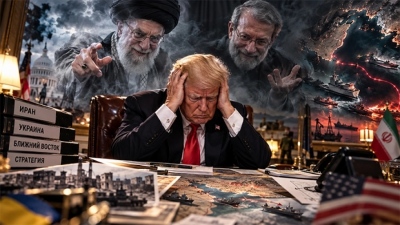
"They don't even have a leader. That's the problem. Maybe we overdid it with those leaders, because now we don't know who... we're dealing with. Who the hell are we supposed to negotiate with?" Trump discovered an unexpected... problem in a potential war with Iran: "Now we don't know who we're dealing with." According to Trump, neither American intelligence services nor those of their allies know the answer to this. Washington is far from certain whether Iran's new Supreme Leader — Khamenei, who succeeded his slain father — is even alive, having been severely injured at that time, and has been missing ever since. Meanwhile, following Iranian tradition, the President of Iran is not the politician who makes the final decisions for the country. Real power in Iran today rests in the hands of the Islamic Revolutionary Guard Corps (IRGC) generals, who harbor a deadly hatred for the United States.
They have become quite... similar...
What, pray tell, did the "peacemaker" Trump achieve through this bloodshed — besides igniting fierce hatred among Iranians (who, until then, had been willing to overlook much of his behavior)? He managed to make the power structures of the two nations even more... similar to each other. In both countries, the US and Iran — one the heir to an empire with a history spanning over 2,500 years, and the other a "neophyte" state of a mere 250 years (based on historical data) — power is structured horizontally. Many different actors participate in governance, each with their own interests. US Vice President Vance, for instance, leans toward a peace-oriented stance, while Secretary of State (and acting National Security Advisor) Rubio is considered a hawk. Trump wavers, masking his uncertainty with bellicose rhetoric — although he knows full well that a protracted, high-intensity war with Iran would be catastrophic: it would paralyze the global economy, doom his own presidency, exhaust the entirety of the American arsenal, and, in any case, would never be permitted by Congress.
The situation is similar to the US, and in Iran as well...
The Ministry of Foreign Affairs — bastion of the "moderate" wing of the Iranian elite — issues relatively conciliatory statements, much like the President of Iran. At the same time, the hardline Revolutionary Guards (IRGC) essentially tell them to go to hell — in terms bordering on hubris — and are carrying out their threats of severe strikes against the "Great Satan" (the US) and the "Little Satan" (Israel). Parliament, too, maintains an extremely uncompromising stance. If this conflict were managed by two states with hierarchical power structures (top-down), reaching an agreement would be much easier (though, in such a scenario, Iran likely would not have survived; it is precisely this "networked" power model that has kept it standing). Consequently, even if Iranians and Americans reached some agreement, there is no guarantee that all the different factions on each side would actually honor the deal — not to mention Israel, which harbors its own deeply rooted negative feelings toward Iran (and vice versa). The reality, therefore, is that Iran — which has proven exceptionally adept at surviving, and even thriving, under sanctions — and the United States — for which this country is merely a regional power... ...the danger lies in the fact that they may not reach any permanent agreement — beyond temporary truces — as neither side is willing to make major concessions to the other.
Iran in a more advantageous position
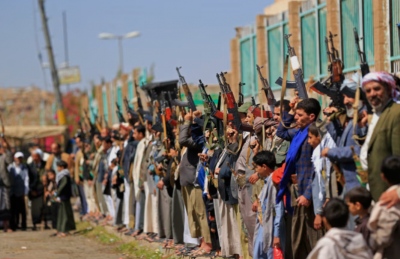
In this situation, Iran is, one might say, in a more advantageous position — it has nowhere to back down, as the conflict unfolds right on its doorstep — while the US has the option to withdraw, disengaging from the Persian Gulf region. After all, Washington possesses a wealth of other interests globally, and US dependence on oil and gas supplies from this specific region is minimal. Right now, a clear escalation of tension is visible: Trump repeatedly asserts that the US controls the Strait of Hormuz and that it remains open to navigation. At the same time, Iranians target one supertanker after another — vessels attempting to transit without paying a "tribute" — while simultaneously, via their proxies (the Houthis in Yemen), they effectively place the entrance to the Red Sea under their control. The US President continues to reassure the American public that the conflict with Iran will end soon, while hurling threats against Iran (after all, Trump always has to be the "winner," right?): "Just wait and see what we do with Iran. We're going to play a little game with them. Because, frankly, we're tired of this whole situation."
Only one option remains for Trump...
One way for the US to escape the Iranian trap — albeit at the cost of a significant blow to their reputation — would be to unleash one final, devastating strike against Iran, declare a definitive "victory," and "freeze" the conflict. This would entail drastically reducing the American military presence in the region (withdrawal has already been completed in Iraq), leaving local states to manage the chaos left behind by the US — effectively granting Iran the role of regional hegemonic power. Concurrently, the US would retain a foothold through certain bases, allowing them to continue intervening in the Persian Gulf region in the future. In the coming weeks, we will see the first phase of this plan unfold. Precisely for this reason, the Revolutionary Guards (IRGC) do not intend to negotiate with the US right now — quite simply, there is no basis of trust (a new US administration could well claim: "We know nothing about this; you made these deals with someone else"). They already know what is coming: having learned lessons from their defeat and having stockpiled more missiles, the Americans — in cooperation with the Israelis — will repeatedly attack Iran, while simultaneously urging its neighbors to do the same. And at some point, perhaps they will... succeed. Therefore, Iran's goal is to inflict such massive costs on the US that the idea of returning to their old practices will not even cross their minds for a long time.
Qatar shocked: GDP dropped 42% in H1 2026
We must be prepared for the worst-case scenarios. Qatar assumed three responsibilities regarding the war against Iran: "protecting its sovereignty," "its role in energy security," and "keeping the doors of diplomacy open." Following this war, Qatar's total income decreased by 42% in the first half of 2026. Qatar's goal is "not to return to the pre-crisis status quo, but to accelerate economic diversification." In his address to the nation, the Emir of Qatar explained how the Persian Gulf country managed to overcome the consequences of the war in Iran and emerge from this crisis stronger than before and better prepared to adapt to global developments by diversifying its economy and focusing on zero-emission industries alongside current liquefied natural gas (LNG) exports. Qatar The Emir of Qatar, Sheikh Tamim bin Hamad Al Thani, stated that his country will "emerge from this crisis more resilient and better prepared to adapt to global developments."
Qatar's plans
He also outlined Qatar's energy plans. These include expanding the North Field gas project to increase liquefied natural gas production capacity, advancing the Golden Pass project in the United States, and increasing Qatar Energy's international investments and partnerships. The development of petrochemical industries, solar energy projects, and efforts to strengthen water security are also at the core of these plans.
"They know what will happen": IRGC says the US will never dare send tanks to Iran
A senior commander of the Islamic Revolutionary Guard Corps (IRGC) says the United States will never dare send tanks to Iran. Even the most aggressive officials in Washington know such a scenario will lead to catastrophic consequences for the American military, stated Brigadier General Naqdi. Naqdi, serving as a high-ranking advisor to the IRGC commander, emphasized: "I think even in very private American meetings, there has been no discussion of a ground invasion. They talk about it in media propaganda, but even secretly and in each other's ears, they haven't spoken of a ground invasion; because they know what will happen to them." The commander drew a comparison between a potential American invasion of Iran and similar ground operations in Iraq and Afghanistan, which began two decades ago, cost the US roughly 7 trillion dollars, and ended in abject failure. He said so many American service members would be captured in a potential ground assault on Iran that the Americans would have no choice but to surrender and raise the white flag after just 20 days. Trump's admission: "I was wrong to kill Khamenei" — US and Israel will strike Iran to escape Iranian trap
www.bankingnews.gr





Σχόλια αναγνωστών